Why Bridging Lenders Decline a Good Bridging Loan Application
Most declines are not about the property. They are about an exit nobody evidenced, an end value the borrower invented, security with a thin buyer pool, a timetable that dies at the solicitor, and an applicant who cannot explain their own deal. What underwriting actually looks at, and what to bring.
Why Bridging Lenders Decline a Good Bridging Loan Application
Got a case you want read honestly before you commit to anything? Talk to us about bridging loans and we will tell you where it will get stuck.
Prefer it in your ears? The episode is Bridging Loans: Why the Exit Decides Everything on the Construction Capital podcast.
A decline stings most when the deal was good. The site was real, the numbers worked on paper, the borrower had done this before, and the answer still came back no. That happens often enough that it is worth explaining properly, because the reasons are consistent and almost none of them are about the building.
We sit between borrowers and a panel of over 100 lenders, and we see the same handful of failure modes over and over. Here they are, in roughly the order they kill applications.
The decline is usually a decline of the story, not the asset
Start with the mental model, because everything below follows from it. A bridging lender is writing a loan of 1 to 18 months secured by a legal charge. It has no long relationship with the debt, no twenty year amortisation to absorb a wobble, and no income stream to fall back on. It has one event that returns its money, and a property it does not want to own.
That means underwriting is not really an assessment of the property. It is an assessment of a claim: that a specific thing will happen, by a specific date, producing a specific sum. The property is the fallback if the claim fails. Most declines are the underwriter concluding that the claim has not been tested by anybody, least of all the person making it.
The uncomfortable version: your deal is not being judged on whether it is good. It is being judged on whether it is legible.
Kill one: the exit is described rather than evidenced
This is the biggest single cause of a no, and it is almost always fixable.
An exit that is described sounds like this. We will sell the units. We will refinance onto a term facility once it is let. My other site completes in the spring and that pays this off. Every one of those may be true. None of them is evidence.
An exit that is evidenced looks different. A memorandum of sale with a buyer named and a price agreed. A decision in principle or a term sheet from the refinancing lender, on headed paper, with the loan amount on it. A signed contract on the asset that is supposed to produce the cash. The difference between those two lists is usually the difference between an offer and a decline on identical security.
There is a second version of this that catches experienced borrowers: an exit that exists but has no realistic runway. A refinance is only an exit if the property will be in a mortgageable condition before the bridge matures. Underwriters model the exit against the calendar, and a plan that only works if nothing slips is a plan that has already failed.
Our first piece of further reading on the network goes deeper on exactly this: why the exit decides everything on a bridge.
Kill two: the end value is the borrower's number, not the market's
Almost every declined application we see has an end value in it that came from the borrower's own arithmetic, an agent's marketing appraisal, or a comparable that was the best one available rather than the most representative.
A valuer will not use any of those. They will pull achieved prices, discount for condition and for the fact that a lender may need to sell in a hurry, and produce a figure that is frequently below what the borrower expected. If your loan only works at your number, it does not work.
The way this shows up in practice is leverage. We arrange bridging loans up to 75 percent loan to value on residential security and 65 to 70 percent on commercial security across our lender panel. Those percentages are applied to the valuer's figure, not yours. A 10 percent haircut on the valuation moves the available loan by tens of thousands and can leave a deal short of the money it needs to complete, which is a decline in everything but name.
Bring your own comparables and be honest about the weak ones. An applicant who says "here are three comparables, and here is why the strongest of them probably overstates my scheme" is an applicant an underwriter believes.
Kill three: the security is fine but the buyer pool is thin
Bridging lenders will secure against stock that mainstream lenders will not touch, and that is the point of the product. A building with no kitchen, a site with consent and no structure, a unit between tenants: all financeable.
What they will not do is ignore how hard the asset would be to sell if the exit fails. The question behind every valuation is who buys this in three months at a price that clears the debt. That is why:
- Residential security prices best and gets the most leverage.
- Commercial security sits lower, at 65 to 70 percent loan to value, because it takes longer to sell and has fewer buyers.
- Genuinely unusual assets, part built schemes, single purpose buildings and anything with a title or access defect, sit lower still or fall outside appetite entirely.
Nothing about that is a judgment on your project. It is a judgment about liquidity in a forced sale, which is the only scenario the credit committee is actually pricing. If your asset has a thin buyer pool, the answer is not a better pitch, it is less leverage, and going in asking for less is often what converts a no into a yes.
Which lenders take which kind of security varies more than borrowers expect. Our analysis of which bridging lenders actually lend on what covers where the appetite sits.
Kill four: the timetable does not survive contact with a solicitor
Speed is the reason most people come to bridging, and the timetable is where a surprising number of applications quietly die.
The lender is rarely the bottleneck. Valuations get booked, credit meets, offers get issued. What holds cases up is the legal side: a title that turns out to be unregistered, an absent lease, a missing indemnity, a leasehold consent nobody chased, a borrower's own solicitor who does not do this kind of work and takes three weeks to acknowledge a pack.
Where this becomes a decline rather than a delay is when the deadline is hard. An auction lot with a 28 day completion has no give in it at all. Miss it and the deposit goes. Underwriting will not commit to a timetable it cannot see being met, so a case that arrives with a hard date and an unprepared legal position often gets declined rather than risked.
The fix is unglamorous and completely within your control. Instruct a solicitor who does bridging work before you need one. Have title, tenure, consents, searches and the schedule of works assembled in one place. Give a valuer access on the first request rather than the third. The auction bridging timetable, from bidding to completion sets out how tight that window really is.
Kill five: the borrower cannot explain their own deal
This one is rarely written down on a decline notice, and it decides more cases than anything except the exit.
An underwriter will ask what the contingency is, what happens if the sale takes six months instead of three, why the works cost what they cost, and where the money comes from if the refinance is declined. There are good answers to all of those. What there is no good answer to is silence, or a figure that has clearly just been produced on the spot.
The pattern we see is a borrower who has bought the property emotionally and not modelled it. They know the purchase price and the hoped for end value and very little in between. A lender reads that as risk in the borrower rather than risk in the deal, and borrower risk is the one thing more security cannot cure.
Credit history matters far less here than in mainstream lending. Bridging lenders take a view rather than applying a score cut off, because the loan is short and secured. Adverse credit narrows the panel and moves the rate. Not being able to explain your own project closes it.
Where a case sits in the range, and what moves it the wrong way
| Term | Indicative on our panel | What pushes it against you |
|---|---|---|
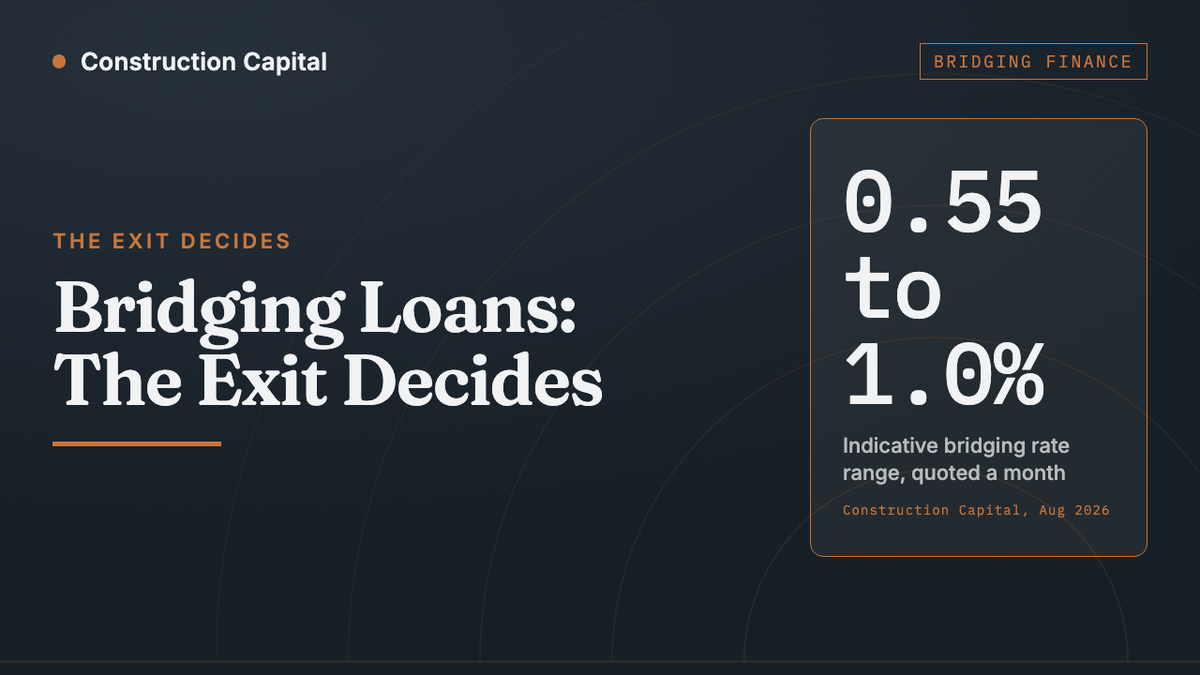
| Monthly interest | from 0.55%, ranging to 1.0% | High leverage, second charge, weak or open exit |
| Loan to value | up to 75% residential, 65 to 70% commercial | Thin buyer pool, unusual asset, title defects |
| Term | 1 to 18 months | A timetable with no contingency in it |
| Arrangement fee | 1 to 2% of the loan | Complexity and the amount of work to place the case |
| Other costs | valuation and legal fees, both sides | Unprepared title and slow conveyancing |
Figures are indicative and vary by lender, security and case. The wider cost of money sits underneath all of it: the Bank of England base rate has been 3.75 percent since December 2025, and bridging pricing moves with each lender's funding lines rather than tracking base rate directly.
What to bring instead
If you want the shortest possible route to a yes, arrive with these.
- The exit, on paper. Memorandum of sale, decision in principle, term sheet, or a signed contract. One document beats ten paragraphs of intention.
- A second exit. Even a weaker one. A borrower with a plan B is a borrower who has thought about failure, and underwriters notice.
- Your own valuation evidence, including the comparables that do not flatter you.
- The full cost stack, works cost with a real contingency, professional fees, finance costs and holding costs, not just purchase and sale.
- A legal pack already assembled, and a solicitor who has done bridging before.
- The borrowing entity settled, personal, limited company or SPV, with the structure behind it explained.
- The honest timeline, with your own slippage built in rather than the lender's discovered later.
None of that changes the property. All of it changes the story, and the story is what gets underwritten.
A decline is information, not a verdict
The last thing worth saying is that a no from one lender is a data point, not a market view. Lenders have different funding lines, different concentration limits and different appetites in any given month, and the same case genuinely does come back priced differently from two lenders in the same week. That is the whole reason a panel exists.
What does not vary is the underwriting logic. A bridge is repaid by an event, and the event has to be believable to somebody who has been lied to professionally for years. Build the case for the event, and the property looks after itself.
If you want a case read before it goes anywhere near a credit team, we arrange bridging loans across a panel of over 100 lenders, and we will tell you when the answer is going to be no and why. More on how we work across development, refurbishment and exit funding is at Construction Capital.
Construction Capital is a trading name of Lenzie Consulting Ltd, registered in England and Wales, company number 08174104. We are a commercial finance broker and introducer, not a lender, and we are not authorised by the FCA. Where a deal is a regulated activity we arrange it through lenders who hold the relevant FCA permissions. Rates and terms are indicative, vary by lender and deal, and are never an offer of finance. Written by Matt Lenzie.