Five Shops, Six Flats: How a Lender Actually Reads Retail Parade Finance in 2026
A retail parade with flats above is not five loans and six loans. It is one rent roll, one split, one stress test and one facility. A practitioner read on how a lender takes a parade apart in 2026: the tenant mix, the uppers, the 40 percent rule, the 125 to 140 percent cover test, and what a...
Five Shops, Six Flats: How a Lender Actually Reads Retail Parade Finance in 2026
Talk to us about financing a retail parade with uppers
Listen on the episode page or browse the show.
Stand across the road from a neighbourhood parade in any market town and count. Five shop fronts at ground level: a convenience store, a pharmacy, a barber, a takeaway and a unit with paper on the window. Six flats above, reached from a shared door at the end of the terrace. One freehold, one landlord, one rent roll. The buyer sees eleven income streams. A lender sees one building and asks one question: how much of that income can be trusted, and at what stress?
We arrange finance on parades like this, and the appraisal a lender runs is nothing like the one in a buyer's head. This is that appraisal, number by number, on a made-up parade so the arithmetic can be shown in full.
Who we are, and what this is. Semi-Commercial Property Finance is a trading name of Lenzie Consulting Ltd (company number 08174104). We are a UK finance arranger and introducer, not a lender. Semi-commercial and mixed-use finance for business and investment borrowers is unregulated lending and sits outside the Financial Conduct Authority's regulated mortgage perimeter, so the business is not FCA authorised. Where an individual borrower will personally live in the residential part of the property, the case can fall under regulated rules and we refer it to a regulated firm. Every figure below is an indicative published band from semicommercialpropertyfinance.co.uk as of mid 2026, not an offer of finance.
The parade on one page
Here is the invented parade. Five shops, six flats, one title, with a valuation of 1,500,000 pounds.
| Unit | Use | Annual rent | Lease position |
|---|---|---|---|
| Shop 1 | Convenience store | 16,000 | 10 years, 6 unexpired |
| Shop 2 | Pharmacy | 14,000 | 15 years, 9 unexpired |
| Shop 3 | Barber | 13,000 | 5 years, 2 unexpired |
| Shop 4 | Takeaway | 12,000 | 10 years, 4 unexpired |
| Shop 5 | Vacant (former card shop) | 11,000 when let | Marketed |
| Flats 1 to 6 | Two-bed flats, 700 pounds a month each | 50,400 | Assured shorthold tenancies |
Fully let, the parade produces 66,000 pounds of commercial rent and 50,400 pounds of residential rent, 116,400 pounds combined. That combined figure is the first thing a lender writes down, because a semi-commercial mortgage on an investment case is sized on both income strands added together, not on the shops alone.
The tenant mix: who is paying and for how long
The shops are read as covenants before they are read as rent. A convenience store and a pharmacy on ten and fifteen year leases are what a lender calls everyday-needs tenants. People still buy milk and collect prescriptions when the economy softens. A barber with two years left and a takeaway with four are thinner: the rent is real today, but the lender is already pricing the chance that the unit is empty at renewal.
So the 66,000 pounds of commercial rent is not weighted equally. Underwriters ask three things of each shop:
- What is the unexpired term, and is there a break clause inside it?
- Who is the tenant: a national operator, a local company with accounts, or a sole trader on a handshake?
- How re-lettable is the unit if that tenant walks, given the pitch and the footfall?
Two strong everyday-needs tenants with the rest on shorter terms is the normal, fundable shape of a parade. It simply draws a more cautious read than one where every lease outruns the mortgage.
The residential uppers: six flats, one void rate
The flats are read differently, and in 2026 they are read generously. Six two-bed flats on assured shorthold tenancies in a town with rental demand are the steadier half of the rent roll: individual flats churn, but six rarely empty at once. The underwriter checks the passing rent against local market rent, the condition of the uppers, and the void history.
Separate access matters more than buyers expect. Flats reached only through a shop are harder to let, harder to value and, on a few lender panels, a reason to decline. Six flats with their own street door are the clean version.
A lender does not fund a parade because it likes shops. It funds a parade because eleven tenancies, half of them residential, make a rent roll that bends without breaking.
Where the split lands against the 40 percent rule
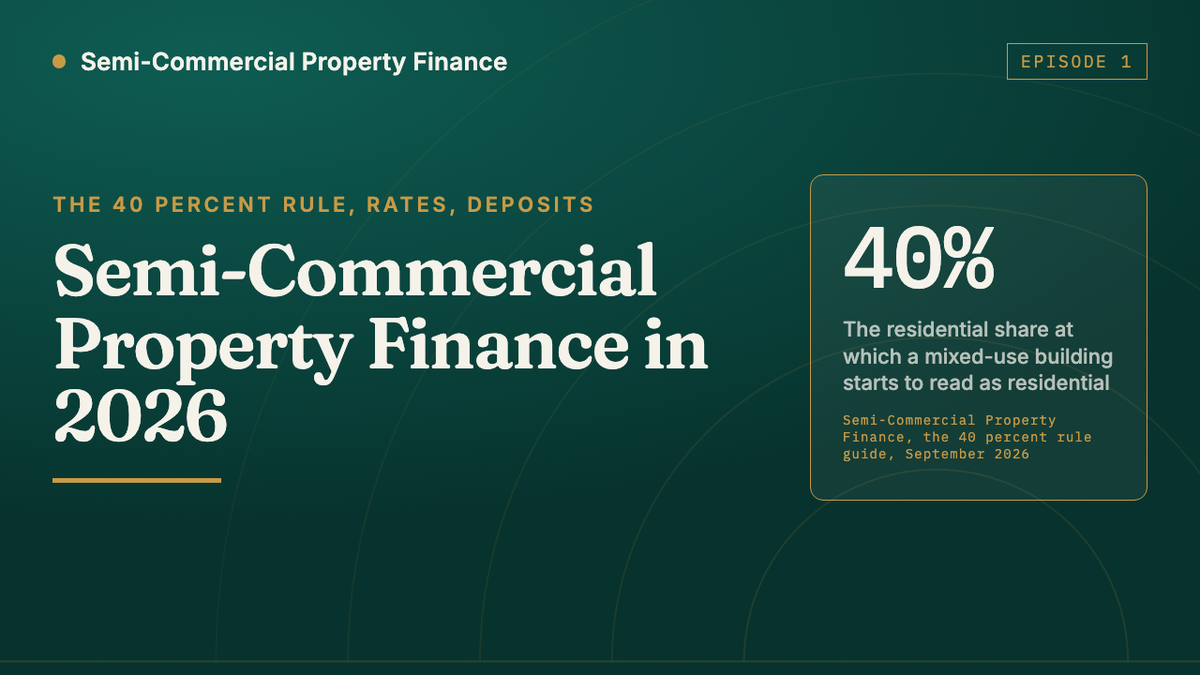
Now the question that decides which lenders are even in the room. The working guideline across the specialist market is that where the residential element is around 40 percent or more of the property, by floor area or by value, lenders lean towards treating it as residential. Below that, it sits in the semi-commercial bucket. It is a guideline, not a statute, and the 40 percent rule guide covers how lenders apply it.
On our parade, run both measures:
- By floor area. Five shops at about 95 square metres each is 475 square metres. Six flats at about 48 square metres each is 288. Residential share: 288 of 763, or 37.7 percent.
- By value. The valuer capitalises the commercial rent and values the flats on comparables. On this parade the residential element comes out at roughly 36 to 38 percent of the 1,500,000 pound total.
Both measures land just under 40 percent, so the full range of specialist semi-commercial lenders and challenger banks will look at it. Convert two of the shops into flats and the residential share climbs past 40 percent, and a different set of lenders with different rules takes over. That boundary is explored further at what the 40 percent rule means for mixed-use lenders.
Stressing the combined rent at 125 to 140 percent
With the parade in the semi-commercial bucket, the loan is sized on interest cover. Lenders test the combined rent against the mortgage interest at a stressed rate, above the pay rate, and require cover of 125 to 140 percent.
Across our lender panel, semi-commercial term mortgages currently price at 6.5 to 8.5 percent a year, with stress rates commonly around 9 percent. Here is what the parade's 116,400 pound combined rent supports at each cover level with a 9 percent stress:
| Required ICR | Maximum interest allowed | Maximum loan at 9% stress | Implied LTV on 1,500,000 |
|---|---|---|---|
| 125% | 93,120 | about 1,035,000 | 69% |
| 130% | 89,538 | about 995,000 | 66% |
| 140% | 83,143 | about 924,000 | 62% |
The arithmetic is rent divided by the cover ratio, then divided by the stress rate: 116,400 / 1.30 / 0.09 is about 995,000 pounds. The headline loan to value for a semi-commercial mortgage is up to 70 to 75 percent, which on 1,500,000 would be 1,050,000 to 1,125,000. The rent will not carry that. On this parade the cover test, not the LTV cap, sets the loan, at roughly 924,000 to 1,035,000 depending on the lender. The full method is in the semi-commercial affordability and ICR guide.
What one vacant unit does to the loan
Shop 5 is the paper-on-the-window unit, and its 11,000 pounds is already excluded from the numbers above. Now suppose the barber, Shop 3, also leaves at the end of its two-year lease. Most lenders will strip a vacant unit out of the rent roll entirely rather than assume a re-let. Combined rent falls to 103,400 pounds.
At 130 percent and 9 percent stress that supports about 884,000 pounds, roughly 111,000 pounds less than the fully let figure. Two empty shops out of five have taken more than a tenth off the loan, while the landlord also carries empty rates and the reletting cost. Hence a rule of thumb we repeat often: on a parade, a void costs you more in borrowing than it costs you in rent.
It also explains why a parade bought with several vacant units is often financed in two steps. Semi-commercial bridging at 8.5 to 11 percent a year, about 0.70 to 0.95 percent a month, completes the purchase and funds the reletting, then the parade exits onto a term mortgage once the rent roll has stabilised. The rates, deposits and lender criteria for that term stage are covered at semi-commercial mortgages in 2026.
The indicative pricing stack for a parade
| Facility | Indicative rate | LTV | When it fits |
|---|---|---|---|
| Semi-commercial term mortgage | 6.5-8.5% a year | up to 70-75% | Fully or mostly let parade held for income |
| Semi-commercial bridging | 8.5-11% a year (0.70-0.95% a month) | up to 70-75% | Auction, speed, or several vacant units |
| Bridge-to-let | 0.70-0.95% a month, then 6.5-8.5% | up to 70-75% | Buy vacant, relet, term out automatically |
| Light refurbishment | 0.70-0.95% a month, 3-12 months | up to 70-75% | Upgrade the uppers or refit a shop |
| Portfolio facility | 6.5-8.5% a year | up to 70-75% aggregate | Several parades under one facility |
All bands are indicative published ranges from our lender panel as of September 2026. The lender arrangement fee on a term facility is typically 1.5 to 2 percent of the loan, with the deposit at 25 to 30 percent on a clean case.
Why a parade is financed as one facility
Buyers sometimes ask whether the flats could be mortgaged separately on buy-to-let terms and the shops on a commercial loan. On a single freehold title the answer is almost always no. A lender wants a first charge over the whole building, because the building is one security. Splitting the title into leasehold flats and a commercial freehold has its own legal cost and tax consequences, and leaves the lender with a weaker security in each part.
There is also a positive reason to keep it whole. A single facility gets full credit for the diversified rent roll: the pharmacy's fifteen year lease helps carry the barber's two, and the six flats cushion the vacant shop. Tested separately, each part looks thinner than the whole.
The same logic scales up. An investor holding three or four parades is usually better served by semi-commercial portfolio finance: one facility across all of them, sized on the portfolio-wide rent at 125 to 140 percent cover and an aggregate LTV of up to 70 to 75 percent, with the ability to add, sell or substitute parades without unwinding the arrangement. We cover that structure at one facility across mixed-use holdings.
The 2026 read
The Bank of England held the base rate at 3.75 percent at its 30 July 2026 decision, with the next decision due on 17 September. Semi-commercial mortgages are priced as a margin over a reference rate, so that hold is why term pricing has settled at 6.5 to 8.5 percent. Stress rates around 9 percent have barely moved, which is why interest cover, not loan to value, remains the binding test on most parades we place.
For the buyer counting shop fronts, the lesson is this. Do not size the loan on the price. Size it on the combined rent at 130 percent and 9 percent, subtract any unit you cannot prove is let, and that is the loan a lender will write.
If you want the same exercise run on a 600,000 pound shop with two flats, from deposit to stamp duty to the remortgage in year five, our companion piece does exactly that: a 600,000 pound shop and two flats, financed on paper.
Talk to us
If you are looking at a parade, send us the rent schedule and the lease dates before you agree a price, and we will tell you what the combined rent supports across our lender panel. The property type is covered at retail parade finance, and you can run your own figures through the semi-commercial mortgage calculator on the site first.
All figures in this article are indicative published bands for UK semi-commercial and mixed-use finance in 2026, not an offer, a quote or a financial promotion, and any facility is subject to lender terms, valuation and full underwriting. This article was written by Matt Lenzie.
Prefer it in slides? The 40 percent rule, the rate bands, the deposit ladder and the interest cover arithmetic are all in the 2026 semi-commercial finance deck, fourteen slides you can skim in two minutes.