Stabilisation Finance in 2026: How Short-Dated Debt Carries a Completed Asset to Stabilised Income
A practitioner read on UK property stabilisation finance in 2026: why a newly built or part-let asset cannot reach term debt straight away, how a lender sizes the path to stabilised income rather than today's, and the eight structures that bridge the lease-up window.
A newly completed commercial property is, on the day it is finished, almost worthless to a long-term lender. That sounds wrong, so it is worth saying plainly. A purpose-built student block handed over in July, a build-to-rent tower that just topped out, a self-storage store that opened its doors last month: each is a finished building producing little or no income. Investment term debt is sized against the income an asset throws off, so until that income arrives, the cheap long-term money will not come. The gap between practical completion and stabilised income is the problem stabilisation finance exists to solve.
We arrange and structure that finance as a broker and introducer. If you are weighing a completion, a lease-up or a refinance, you can start with us at Stabilisation Finance. We are not a lender. We place the deal with the right camp for the asset and the stage it has reached, across specialist real estate debt funds, bridging lenders, challenger banks, senior investment lenders and mezzanine providers.
This is a working summary of what stabilisation finance is in 2026, how a lender sizes it, and the eight structures that carry an asset from completion to stabilised income and then onto a term loan or a sale.
The one idea that explains stabilisation finance
Stabilisation finance is short-dated debt that carries a newly built, refurbished or recently let property from practical completion, through lease-up and the income ramp, to the stabilised income a long-term lender wants. Once the asset reaches that stabilised income, it refinances onto cheaper investment term debt, or it is sold.
The single fact that runs through every term sheet in this market is this: the lender sizes on the path to stabilised income, not on today's income. A development lender funds bricks. A term lender funds a settled rent roll. Stabilisation finance sits in between, and it is the only money in the chain that is comfortable lending against an income that does not yet exist but can be shown to be coming. The lender prices the window on its length and its certainty. The longer and less certain the lease-up, the higher the margin and the lower the day-one advance.
That is why loan to value during lease-up typically sits at 65 to 75 percent of value. The lender is protecting itself against the lower day-one value while lending against the path to the higher stabilised one. Get the lease-up plan into the shape a lender reads first, and the whole structure follows from it.
The 2026 backdrop, in plain numbers
The pricing anchor is the Bank of England base rate, held at 3.75 percent since the December 2025 cut, on Bank of England data. Stabilisation debt is short-dated and priced per month or per year, while senior investment term loans are priced as a margin over SONIA or base, or as a fixed rate. So the base rate sets the floor under the cost of carrying an asset through its lease-up.
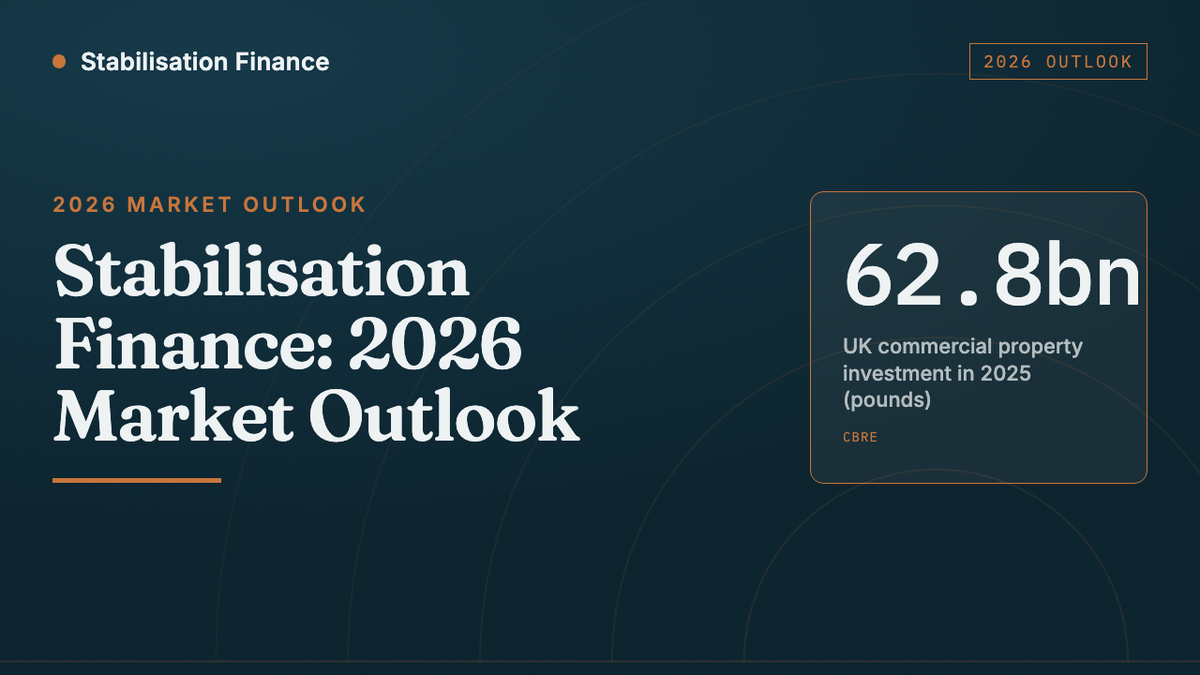
The exit side has improved. UK commercial real estate investment reached 62.8 billion pounds in 2025, on CBRE figures, with a strong fourth quarter of 26.6 billion pounds, up 36 percent on the same quarter a year earlier. Healthcare led at 12.9 billion pounds, Living at 12.0 billion and Offices at 10.4 billion. A recovering investment market means a deeper pool of capital waiting to refinance a stabilised asset, which is exactly what makes the stabilisation trade work.
Prime yields are the spine of the maths, because value is income divided by the yield. On Knight Frank and Savills guidance, prime distribution warehouses sit around 5.00 to 5.25 percent, prime City offices around 5.25 percent, prime Greater London build-to-rent around 4.25 percent, prime UK self-storage around 5.0 percent, and prime regional PBSA around 5.25 to 5.50 percent. A tighter prime yield means a higher stabilised value and a deeper pool of refinancing money, so the yield does double duty: it sets the value the asset reaches, and it tells the lender how liquid the exit will be.
The short-dated lending market that funds this is sizeable and growing. The BDLA put the UK bridging and development loan book at around 13.4 billion pounds at the end of Q4 2025, up over 50 percent year on year, with development lending rising to about 420.3 million pounds in the quarter. Average bridging completion times fell to 43 days in 2025, the fastest since 2017, on Bridging Trends data.
How a lender sizes the window
Four tests do the work, and they are forward-looking by design.
- Loan to value during lease-up. Tested against a rising value as the asset lets up, with the day-one advance set conservatively at 65 to 75 percent.
- The occupancy trajectory. The lettings or absorption plan, lets per week or per month, is the metric the underwriter tracks. A credible curve is the heart of the case.
- Debt yield at stabilisation. Stabilised net income over the loan. This sets whether a term lender will take the asset out at the planned point.
- Interest cover at the stabilised point. Debt service cover, or interest cover, has to clear the lender's threshold before the refinance can happen, even though it may not clear on day-one income.
Margins often step down as the asset hits agreed lease-up milestones, which rewards a tight plan and pushes the borrower to stabilise faster. The covenant question is not whether today's income covers the debt. It is whether the path to stabilised income is believable.
Day-one value versus stabilised value
This is the framing that makes everything click. Day-one value is the value at practical completion or part-let, when income is low or nil. Stabilised value is the value once the asset reaches its mature, fully-let income, capitalised at the prime yield for its sector. The gap between the two is the stabilisation window, and the cost of bridging it is set against the value and income it produces.
No single published figure captures that gap, because it is specific to each asset. But the mechanics are universal: a lease-up asset does not transact at the prime yield until it is stabilised, which is the whole reason stabilisation finance exists. We model the day-one to stabilised gap on every case at stabilisationfinance.co.uk, and the full 2026 outlook runs as a market outlook guide.
The eight structures, and the numbers
These are indicative 2026 bands for UK property stabilisation finance. They are market commentary, not a quote or an offer, and real terms are set case by case by individual lenders.
| Structure | What it does | Indicative 2026 terms |
|---|---|---|
| Stabilisation bridge | Carries an asset through lease-up | up to 65% to 75% LTV during lease-up, 12 to 24 months |
| Development exit | Repays the development loan after completion | up to 70% to 75% LTV, 6 to 18 months, priced below the dev loan |
| Bridge-to-term | A bridge with the term loan arranged alongside | up to 70% to 75% LTV on the bridge, term sized on stabilised income |
| Lease-up | Funds the lease-up of a completed scheme | up to 65% to 75% LTV, 12 to 24 months, sized on projected income |
| Refurbishment-to-stabilisation | Funds works plus lease-up | up to 70% to 75% LTV plus works funding, 12 to 24 months |
| Mezzanine and preferred equity | Stretches senior debt to fill the equity gap | senior plus mezzanine up to 85% to 90% of cost |
| Cash-out refinance | Releases equity once stabilised | up to 70% to 75% of revalued investment value, 5 to 25 years |
| Senior investment term loans | The long-term exit on a stabilised asset | up to 65% to 75% LTV, 5 to 25 years |
A few notes matter more than the headline numbers:
- Development exit is priced below the development loan it replaces, because the build risk has gone. It repays the dev loan, funds the sales or lettings period and can release equity. Our development exit guide sets out how.
- Bridge-to-term arranges the exit at the same time as the bridge, so the term loan is underwritten on the income the asset reaches, not today's. That is covered in the bridge-to-term guide.
- Lease-up finance is sized on projected stabilised income, with the occupancy trajectory and lettings plan doing the heavy lifting. See the lease-up finance guide.
- Refurbishment-to-stabilisation funds up to 100 percent of works in stages against a monitoring surveyor's certification, then carries the asset through lease-up. The detail is in the refurbishment-to-stabilisation guide.
- Mezzanine and preferred equity fill the gap between the senior advance and the developer's equity, behind the senior lender and in front of ordinary equity. See the mezzanine and preferred equity guide.
Across asset classes: same structure, different income basis
The stabilisation structure is identical across asset classes. Complete or reposition, lease up or ramp trading, reach stabilised income, refinance. What differs is the income basis the lender underwrites, and that changes how the debt is sized and priced.
Build-to-rent typically targets about 80 percent occupancy within twelve months of going live, then ramps above 95 percent, on CBRE and Association for Rental Living data. Self-storage fills gradually, with a lease-up of roughly three years to a mature level, on Cushman and Wakefield and SSA UK figures. PBSA lets up across a single concentrated September intake, and the 2025/26 cycle saw private-sector occupancy soften to about 85.4 percent, on StuRents data, so first-cycle risk is priced more carefully. Hotels ramp over about 18 to 36 months, and care homes over roughly 12 to 24 months, on Knight Frank figures. A lender reads the income basis to judge how fast and how certain the stabilised income is.
Who funds it
This is a specialist market, which is why a broker earns their keep. The deepest appetite for the short-dated end, stabilisation bridge, development exit, lease-up and refurbishment, sits with specialist real estate debt funds and bridging lenders. Challenger banks come in once an asset is stabilised and well let. The keenest senior term debt on prime stabilised assets comes from senior investment lenders, including clearing and insurance-backed lenders. For the stretch above senior debt, mezzanine and preferred-equity providers fill the gap.
We match the lender camp to the structure and the stage the asset has reached. We never describe a single lender's terms as an offer, and we place across the whole market.
Talk to us
If you are carrying an asset from completion toward stabilised income, get the lease-up plan, the day-one and stabilised values, and the debt yield and cover at the exit into the shape a lender reads first. Then we can place the bridge, the lease-up loan, the refurbishment facility or the term exit with the right camp. Talk to us about stabilisation finance.
Figures cited here are drawn from the Bank of England, CBRE, Savills, Knight Frank, the BDLA and Bridging Trends, and are indicative market commentary.
Listen, watch and read more
- Hear the full episode on the Stabilisation Finance podcast, on Apple Podcasts, or on Spotify. You can also follow on Pocket Casts, Overcast, Deezer, Player FM, Podcast Addict, Castbox, Castro, Goodpods or Metacast, or via the RSS feed.
- Watch the 2026 market outlook on YouTube.
- Go deeper: What a lender actually sizes on a stabilisation loan and The eight structures of stabilisation finance.
- Explore the full Stabilisation Finance 2026 hub and the resource index.
This article is general market commentary, not financial advice, and not an offer of finance. Stabilisation Finance is a broker and introducer, not a lender. We are not authorised by the Financial Conduct Authority. The lending we arrange is, in most cases, unregulated commercial lending. Where a deal involves a regulated element, we refer it to an appropriately regulated firm. Indicative terms, rates and loan-to-value bands are illustrative and vary by lender, asset and scheme.
Written by Matt Lenzie. Podcast hosted by Georgina. Published by Stabilisation Finance.