What Is Getting Funded in UK Medical Centre Property in 2026, and on What Terms
A practitioner overview of UK primary care and medical centre property finance in 2026: why NHS reimbursed rent drives pricing, and the indicative numbers behind acquisition, development, refinance and bridging.
If you own, run or are buying a GP surgery or a medical centre in the UK, the finance market in 2026 is busy but particular. Lenders have appetite, and they are backing modern, well let premises where the rent is underpinned by the NHS. The whole thing turns on one point: a medical centre is an income asset, and it is the security of that income, not just the value of the building, that sets your terms. If you want to talk through where your premises sits, start with Medical Centre Property Finance, which reads a surgery the way a lender reads it and then takes it to the right desk. This is a working overview of what is actually being funded this year and on roughly what numbers.
Why NHS reimbursed rent sets the price
Most GP surgery and primary care premises are underpinned by rent that the NHS reimburses. For a practice that owns its building, that comes through as notional rent, also called Current Market Rent, paid to the GP contractor. For a let centre, the practice pays the rent and the local Integrated Care Board reimburses the cost. Either way, the cash flow behind the loan is effectively government backed and rarely defaults.
That single feature is why primary care prices more finely than ordinary commercial property. A lender is not really lending against consulting rooms and a car park. It is lending against a long, dependable, NHS supported income stream, so it will accept a lower margin and offer more leverage than it would on a shop or a small industrial unit of the same value.
Notional rent is assessed by the District Valuer Services or, since the 2024 rules, an approved chartered surveyor, and it is reviewed roughly every three years. The other number lenders watch on a let centre is the WAULT, the weighted average unexpired lease term. Long unexpired terms on a modern, purpose-built centre command the keenest pricing and the highest leverage. Short leases on an older, tired surgery widen the margin and cap how much you can borrow.
The 2026 backdrop
The pricing anchor is the Bank of England base rate, held at 3.75 percent since the December 2025 cut, with the next decision due on 30 July 2026 and CPI inflation running around 2.8 percent. Term debt on a medical centre is quoted as a margin over base rate or a reference rate, so a steady base rate gives borrowers a firmer footing for the year. Treat every figure here as indicative market commentary rather than a quote.
Investor demand is strong. UK healthcare real estate drew over 12 billion pounds of investment in 2025 on the Savills measure, the highest annual total on record, with primary care making up around 16 percent of that activity. Prime primary care yields sat at about 4.5 percent through 2025, again on Savills numbers, which keeps primary care the keenest yielding, lowest risk part of the healthcare sector. When investors compete that hard for the income, lenders are comfortable funding against it.
There is a supply story underneath all this too. A large slice of the GP estate is old and undersized, roughly half of it more than thirty years old, and government funds such as the 102 million pound utilisation and modernisation programme are pushing new development. So 2026 is a market with genuine appetite on both the investment and the funding side, tilted toward modern, compliant, NHS backed space.
The funding routes, and the numbers
Below are indicative 2026 bands for UK GP surgery and medical centre property. They are market commentary, not a quote or an offer, and real terms are always set case by case.
| Funding route | Indicative pricing | Typical leverage | Typical term |
|---|---|---|---|
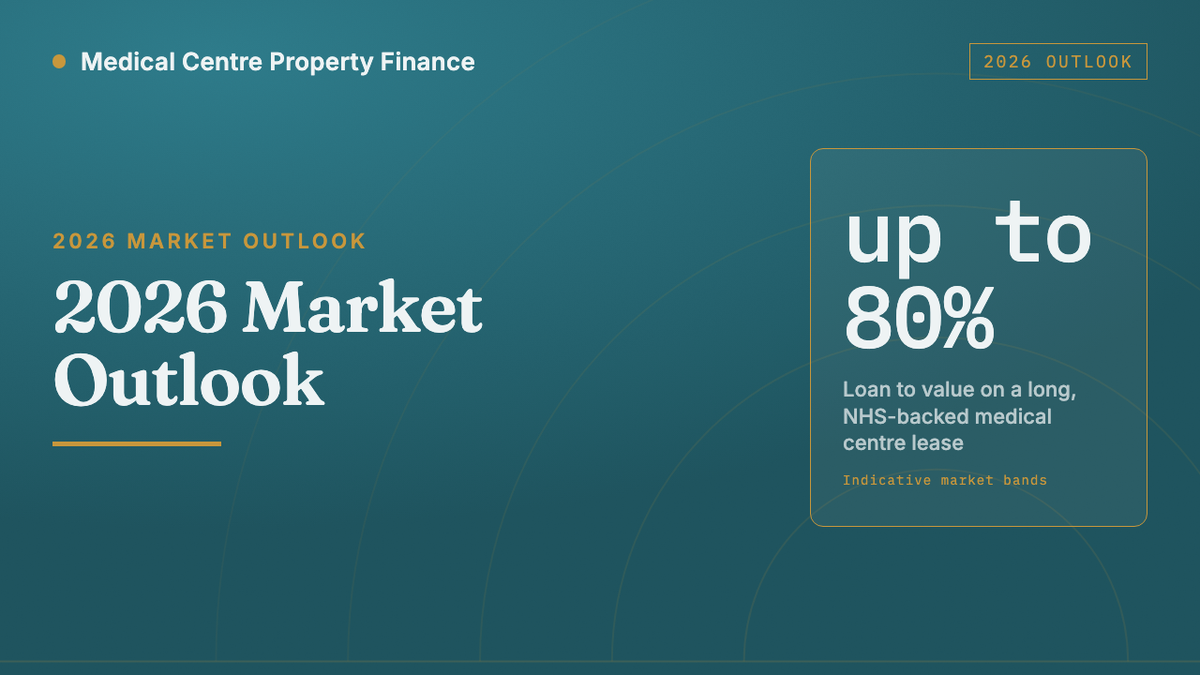
| Senior term debt | around 5.5% to 7.0% all in (roughly 1.75% to 3.25% over base or reference rate) | around 65% to 80% LTV, upper end on long NHS reimbursed leases | 5 to 25 years |
| Owner occupier GP mortgage | around 5.75% to 7.25% all in (roughly 2.0% to 3.5% over base) | toward the upper LTV end where notional rent supports service | 5 to 25 years |
| Development and refurbishment | drawn in stages, interest often rolled up | around 65% to 75% of cost, up to around 65% to 70% of GDV | build plus let up |
| Mezzanine | around 10% to 16% a year | stretches total leverage above senior | alongside senior |
| Bridging | around 0.70% to 1.00% a month | speed led, exit driven | up to 12 to 18 months |
A few points matter more than the headline rate. Arrangement fees are typically around 1 to 2 percent of the facility. Lenders usually want debt service cover of around 1.25 to 1.5 times, which is lower than they ask on trading property precisely because the reimbursed income is so predictable. And interest only is common where the income is long, well let and NHS reimbursed, which keeps monthly cost down over a long term.
Acquisition
Buying a let medical centre or an owner occupied surgery sits on senior term debt, usually around 65 to 80 percent loan to value. A modern, purpose-built, CQC compliant centre on a long lease with the rent reimbursed by the NHS reaches the top of that range. An older surgery, or one with a higher share of non-reimbursed commercial income from a pharmacy or private clinic, is typically capped nearer 60 to 70 percent, because that slice of income is treated more cautiously.
Development and refurbishment
New neighbourhood centres and refurbishments are funded in drawdowns against the build programme, at around 65 to 75 percent of cost and up to about 65 to 70 percent of gross development value. Interest is often rolled up through construction and let up. A pre-let to a GP practice, or an agreement backed by NHS reimbursement, de-risks a scheme and supports leverage at the upper end. Where an experienced developer needs to stretch total leverage and trim the equity cheque, mezzanine at around 10 to 16 percent a year can sit behind the senior facility.
Refinance and equity release
Refinancing is a large part of what is moving in 2026. Owners come off an existing facility, capture a keener margin, release equity against a valuation that has firmed up, or reset onto a longer interest only term. Because primary care rents have grown slowly, on average below 2 percent a year over the past decade, many older surgeries sit below open market rent, so the next three yearly review can lift value and support a larger loan. Watch for early repayment charges on the facility you are leaving. Our guide on NHS reimbursement and lease-backed primary care premises finance goes deeper on how the income basis shapes what you can raise.
Bridging
Bridging covers the speed led and transitional situations: an auction purchase, buying out a retiring partner's share, funding a centre before an NHS backed lease completes, or carrying a refurbishment toward a term debt exit. It runs at around 0.70 to 1.00 percent a month, for up to 12 to 18 months, and always needs a clear, evidenced exit, usually a refinance onto term debt or a sale to an investor.
What actually swings your terms
Two surgeries with the same rent can be offered very different deals. The swing factors are structural: the share of income that the NHS reimburses, the lease length and WAULT, the building's quality and compliance, and the ownership model, whether owner occupier GP partners on notional rent, an investor let, or a third-party developer or REIT structure of the kind Assura and Primary Health Properties operate as landlords. Get those in good order and you borrow against the larger, safer number.
We never name individual lenders. In practice the market sorts into three camps: specialist healthcare and primary care lenders with the deepest appetite and the best grasp of NHS reimbursement, challenger banks competing on well let established centres, and high-street banks, the most conservative, favouring modern premises and long reimbursed leases. Knowing which camp fits your premises saves a lot of wasted time. If you want a second read on where yours lands, talk to Medical Centre Property Finance.
Go deeper
We have published a full set of guides across the whole capital stack, plus a podcast and a hub that ties it together. Start with the 2026 medical centre finance market outlook, then work through the route that fits, whether that is acquisition, development, refinance, owner occupier versus investor, bridging, or portfolio finance. The full overview also runs as a podcast, hosted by Georgina.
Figures cited here are drawn from Savills, the Bank of England, Knight Frank, NHS and BMA sources and REIT reporting, and are indicative market commentary only, not quotes or offers.
Medical Centre Property Finance is an information resource and is not FCA authorised; nothing here is financial advice or an offer of finance, and you should take professional advice for your own situation.
Written by Matt Lenzie. Podcast hosted by Georgina. Published by Medical Centre Property Finance.