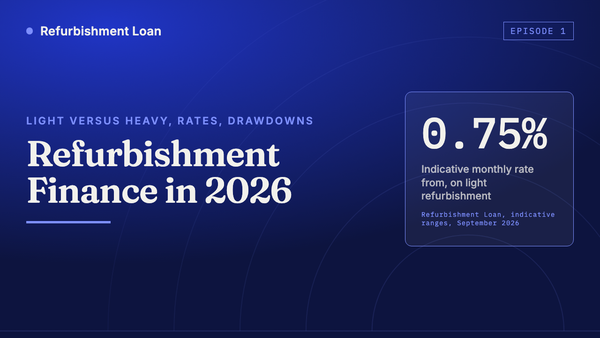
Hotel Finance in 2026: What Is Actually Getting Funded, and on What Terms
A practitioner read on UK hotel finance in 2026: how lenders price a trading hotel, the funding routes that are moving, and the numbers behind acquisition, development, refinance and bridging.

If you own, run or are buying a UK hotel, the finance market in 2026 is more open than it has been in a while, but it is selective. The lenders with appetite are backing strong, well run trading hotels, and they are pricing on the business, not just the building. This is a working summary of what we are seeing, how the numbers stack up, and where the funding is actually coming from.
Talk to us about your situation as market commentary: Hotel Property Finance. We help owners, operators and investors read their trading story the way a lender reads it, then take it to the right lender.
Prefer audio? The full 2026 outlook is on the podcast, hosted by Georgina:
Listen on the podcast home, or on Apple Podcasts, Spotify and Amazon Music.
The one idea that explains hotel finance
A hotel is not financed like a shop or a warehouse. It is a trading business that happens to own property, and a lender funds both together. So the first question is never only what the bricks and mortar are worth. It is how much sustainable cash the operation produces, and how dependable that cash looks.
That is why hotels are valued on a going-concern basis by a chartered surveyor, reflecting the income the business generates, which usually sits above the vacant-possession value of an empty building. Weak trading, a lost brand or an interrupted operation pushes the value back down toward the bricks. Get the trading story right and you borrow against the larger number.
The metrics that decide your terms are the ones operators already live by:
- RevPAR, revenue per available room, which is roughly average daily rate multiplied by occupancy. It is the headline trading number.
- ADR and occupancy, the two parts of RevPAR a lender wants to see moving in the right direction.
- EBITDA, the profit measure lenders underwrite against, usually adjusted for a management charge and a reserve for furniture, fittings and equipment.
The 2026 backdrop
The pricing anchor is the Bank of England base rate, held at 3.75 percent since the December 2025 cut. Hotel term debt is quoted as a margin over base, so a steady base rate gives everyone a firmer footing for the year.
The trading picture is solid. STR, the hospitality benchmarking arm of CoStar, put UK hotel occupancy at around 76 percent through 2025. Behind that recovery, JLL points to strengthening debt markets and record dry powder driving hotel investment in 2026, and Savills, CBRE and Knight Frank each describe an improving appetite to lend against the asset.
The shape of the year is refinancing led and selective. We have seen landmark London refinancings running into the hundreds of millions, specialist lenders funding new branded budget and lifestyle hotels in London, Manchester and Edinburgh, and genuine distress at the other end, including a West End hotel guided above 275 million pounds. Strong assets refinance comfortably while weaker ones change hands, which is exactly what you expect at this point in the cycle.
The funding routes, and the numbers
These are indicative 2026 bands for UK trading hotels. They are market commentary, not a quote or an offer, and real terms are set case by case by individual lenders.
| Funding route | Indicative 2026 pricing | Typical leverage |
|---|---|---|
| Senior term debt | 6.5% to 8.5% all in (around 2.75% to 4.75% over base) | 55% to 70% LTV, going concern |
| Development and refurbishment | margin over base, sized in stages | 60% to 65% of cost and of GDV |
| Mezzanine | 11% to 18% a year, behind the senior lender | tops up the senior facility |
| Bridging | 0.85% to 1.25% a month | up to 12 to 18 months, clear exit needed |
A few notes that matter more than the headline rate:
- Senior debt runs long. Terms of 10 to 25 years are normal, often part-amortising, with interest-only available for stronger operators or lower-leverage deals.
- Development is sized twice, against total cost and against gross development value, with mezzanine able to stretch total leverage when the scheme supports it.
- Bridging always needs an exit. It is priced for speed and short duration, so a clear route to a refinance onto term debt, or a sale, is the price of entry.
- Affordability is tested on cover. Lenders commonly look for debt service cover of around 1.4 to 1.75 times on sustainable earnings.
What actually moves your pricing
Two hotels with the same RevPAR can be offered very different terms. The swing factors are structural:
- Branded or flagged versus independent. A recognised brand brings demand and distribution; a strong independent is judged on its own record.
- Freehold versus leasehold. Freehold or long leasehold supports higher leverage than a short or onerous lease.
- Owner-operator versus investor, and the op-co prop-co split, which changes who borrows, how security sits and how the deal prices.
- Operator track record. Experienced multi-site operators see keener terms than first-time operators, who usually face lower leverage.
We never name individual lenders. In practice the market sorts into three camps: specialist hospitality lenders with the deepest appetite, challenger banks competing on stabilised well-located hotels, and high-street banks, the most conservative, favouring established operators with strong brands and freehold security. Knowing which camp fits your deal saves a lot of wasted time.
Go deeper
We have published a full set of guides, one per funding route, plus a podcast and a video, and a single hub that ties it together:
- The hub: Hotel Property Finance 2026 Market Outlook.
- The 2026 hotel finance market outlook.
- Hotel acquisition finance, for buying a trading hotel.
- Hotel development and refurbishment finance, for building and upgrading.
- Hotel bridging finance, for speed-led situations.
The whole 2026 outlook also runs as a podcast and a video.
Talk to us
If you are weighing a purchase, a development, a refinance or a bridge, the best first step is to get your trading story and your numbers into the shape a lender reads. Talk to us about hotel finance.
Figures cited here are drawn from STR and CoStar, JLL, Savills, CBRE and Knight Frank, plus Construction Capital planning data, and are indicative market commentary.
This article is general market commentary, not financial advice, and not an offer of any kind. We are not FCA authorised. Commercial finance on hotel property is generally unregulated business lending. Where regulated activity is required, we introduce to FCA-authorised firms. Take professional advice for your own situation.
Written by Matt Lenzie. Podcast hosted by Georgina. Published by Hotel Property Finance.