Care Home Finance in 2026: What Lenders Are Really Looking At
A practitioner read on UK care home finance in 2026: why the CQC rating swings your terms, how EBITDARM drives leverage, and the funding routes behind buying, building and turning around a home.
The UK care home sector has a demand story almost nobody disputes and a supply story that keeps capital arriving. For anyone who owns, runs or is buying a home, 2026 is a year where finance is available, but it is firmly tiered by quality. This is a working summary of what lenders are actually looking at, and what it means for your terms.
Talk to us about your situation as market commentary: Care Homes Finance. We help operators, buyers and investors present a trading home the way a lender underwrites it, then match it to the right lender.
Prefer audio? The full 2026 outlook is on the podcast, hosted by Georgina:
Listen on the podcast home, or on Apple Podcasts, Spotify and Amazon Music.
A care home is financed as a business
A trading care home is not funded like an ordinary building. It is underwritten as a specialist operating business that happens to own property, so a lender looks first at the cash the home generates and the quality of the operation, and only then at the bricks and mortar.
That is why a home is valued on a going-concern basis, usually well above its bricks-and-mortar value. The profit measure lenders underwrite against is EBITDARM, earnings before interest, tax, depreciation, amortisation, rent and management. Because value is a multiple of those maintainable earnings, anything that moves the earnings moves both your leverage and the value of the asset itself.
The demand and supply backdrop
The structural demand is the part nobody argues with. The Office for National Statistics puts the UK population aged 85 and over at around 1.75 million in mid-2024 and projects it to roughly double to 3.6 million by 2049. That cohort is the core driver of care demand, and a doubling over twenty five years is why long-term capital keeps arriving.
Supply has not kept pace. Carterwood has projected the UK to be short of nearly 277,000 modern, market-standard beds by 2026, and LaingBuisson notes that a large share of current capacity is not purpose built. Investment has followed the thesis, with Savills reporting record annual healthcare real estate volumes, and CBRE finding the large majority of healthcare investors looking to deploy more capital.
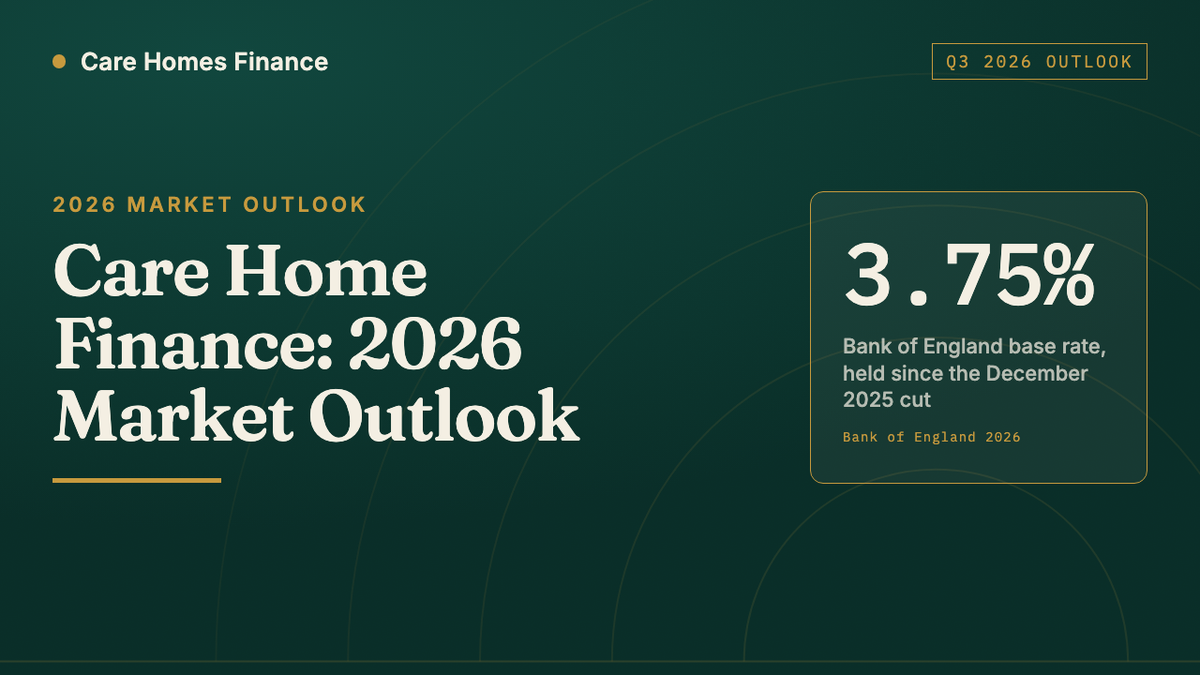
The pricing anchor is the Bank of England base rate, held at 3.75 percent since the December 2025 cut, which underpins 2026 affordability since term debt is quoted as a margin over a reference rate.
The CQC rating is the biggest single swing factor
More than any other variable, the Care Quality Commission rating moves both appetite and price. Profitability tracks down the rating bands, and a downgrade does not just dent margin, it cuts the multiple applied to those earnings, so the hit to value is larger than the hit to profit. Lenders read the rating as a proxy for operational risk, occupancy resilience and the chance of a forced sale.
Alongside the rating, three operating drivers do most of the work:
- Occupancy of registered beds, with stabilised homes commonly modelled in the high 80s.
- Fee mix, the split between self-pay and local-authority funded residents.
- Scale, since larger homes tend to carry stronger operating leverage and margin per bed.
The funding routes, and the numbers
These are indicative 2026 bands for UK trading care homes. They are market commentary, not a quote or an offer, and real terms are set case by case by individual lenders.
| Funding route | Indicative 2026 pricing | Typical leverage |
|---|---|---|
| Senior term debt | around 6.0% to 7.5% all in | 60% to 70% LTV, going concern |
| Development and extension | margin over base, drawn in stages | 60% to 70% of cost, up to 60% to 65% of end value |
| Bridging | speed-led, short term | up to 12 to 18 months, clear exit needed |
| Distressed and turnaround | priced for risk | sized to the recovery plan and exit |
A few notes that matter more than the headline rate:
- Experience changes everything. Established multi-home operators see higher leverage than first-time buyers, who usually face lower gearing and tighter terms.
- Development is sized twice, against cost and against end value, with interest often rolled up over the build.
- Bridging always needs an exit, usually a refinance onto term debt once the home is stabilised and re-rated, or a sale.
- Turnaround funding follows a plan. Where a rating has slipped, the deal is built around the cost and the credibility of the recovery, then the exit.
We never name individual lenders. In practice the market sorts into three camps: specialist healthcare lenders with the deepest appetite, challenger banks competing on stabilised well-rated homes, and high-street banks, the most conservative. Knowing which camp fits your home saves a lot of wasted time.
Go deeper
We have published a full set of guides, one per funding route, plus a podcast and a video, and a single hub that ties it together:
- The hub: Care Home Finance 2026 Market Outlook.
- The 2026 care home finance market outlook.
- Care home acquisition finance, for buying a trading home.
- CQC ratings, distressed and turnaround finance, where the rating bites hardest.
The whole 2026 outlook also runs as a podcast and a video.
Talk to us
If you are weighing a purchase, an extension, a refinance or a turnaround, get your trading story, your occupancy and your CQC position into the shape a lender reads first. Talk to us about care home finance.
Figures cited here are drawn from Knight Frank, Savills, CBRE, Carterwood, LaingBuisson, the ONS and the CQC, plus Construction Capital planning data, and are indicative market commentary.
This article is general market commentary, not financial advice, and not an offer of any kind. We are not FCA authorised. Commercial finance on care home property is generally unregulated business lending. Where regulated activity is required, we introduce to FCA-authorised firms. Take professional advice for your own situation.
Written by Matt Lenzie. Podcast hosted by Georgina. Published by Care Homes Finance.